Push the risk to partners you trust, keep your time for the product
Heilo hands files, email, network and AI to partners who deal with those risks every day. Why, and why startups and solo builders can do the same with support.
Getting started3 min read
Building a product, risk is everywhere: a disk fails, a server gets overloaded, an email lands in spam. For a small team, the safest move isn't to carry all of it yourself. It's to push each risk to a partner you trust, one that deals with that exact risk every day.
Heilo is built that way, and I think you can do the same with your customer support.
What pushing risk means
Do it yourself and you carry it yourself. Hand it to a partner that specializes in it, and the risk moves to people with an engineering team on call day and night and a clear commitment in their SLA. Everything keeps working as usual, and when something goes wrong on their side, their team handles it and their SLA covers you.
The risks Heilo pushed away
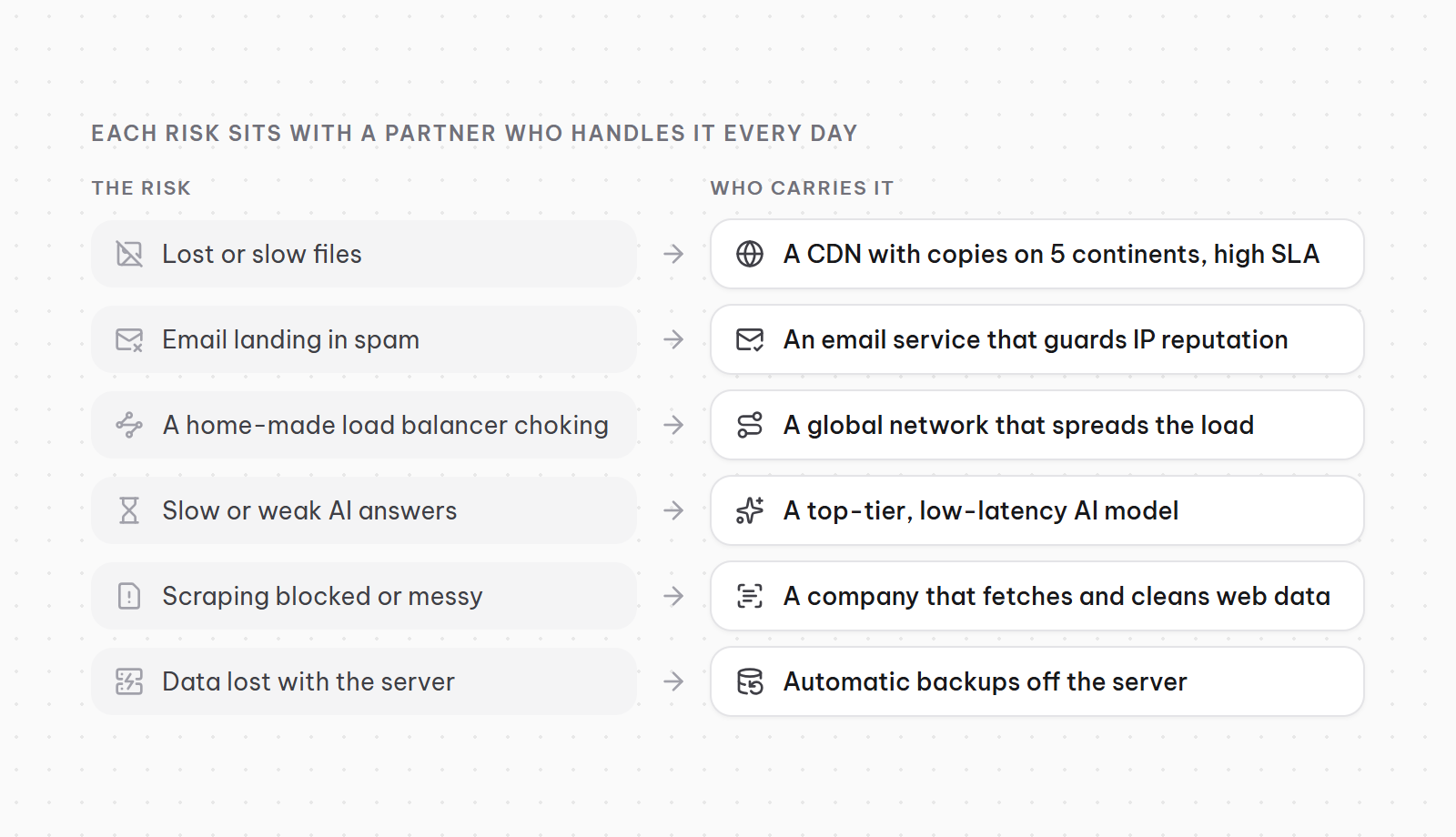
- Lost or slow files. Chat files sit on a CDN with copies on 5 continents, sent to customers from the nearest point, with a high SLA.
- Email landing in spam. Heilo doesn't run its own mail server. Email goes out through a service that looks after IP reputation and the sending setup.
- A home-made load balancer choking. Heilo doesn't build its own load balancer. Traffic goes through the global network of a partner that specializes in routing and spreading load, before it reaches Heilo's server.
- Slow or weak AI answers. Heilo picks a top-tier, low-latency AI model. Your conversations are not used to train it.
- Scraping that gets blocked or comes back messy. Websites have complex structures, so Heilo uses a company that specializes in fetching web data. They clean the data up, so the AI assistant understands your website more deeply.
- Data lost with the server. The database is backed up automatically to separate storage, off the server.
Pushing risk is only safe when the partner deserves trust. Heilo picks its partners with care and lists the ones that process data on the sub-processors page.
Don't let your app become two apps
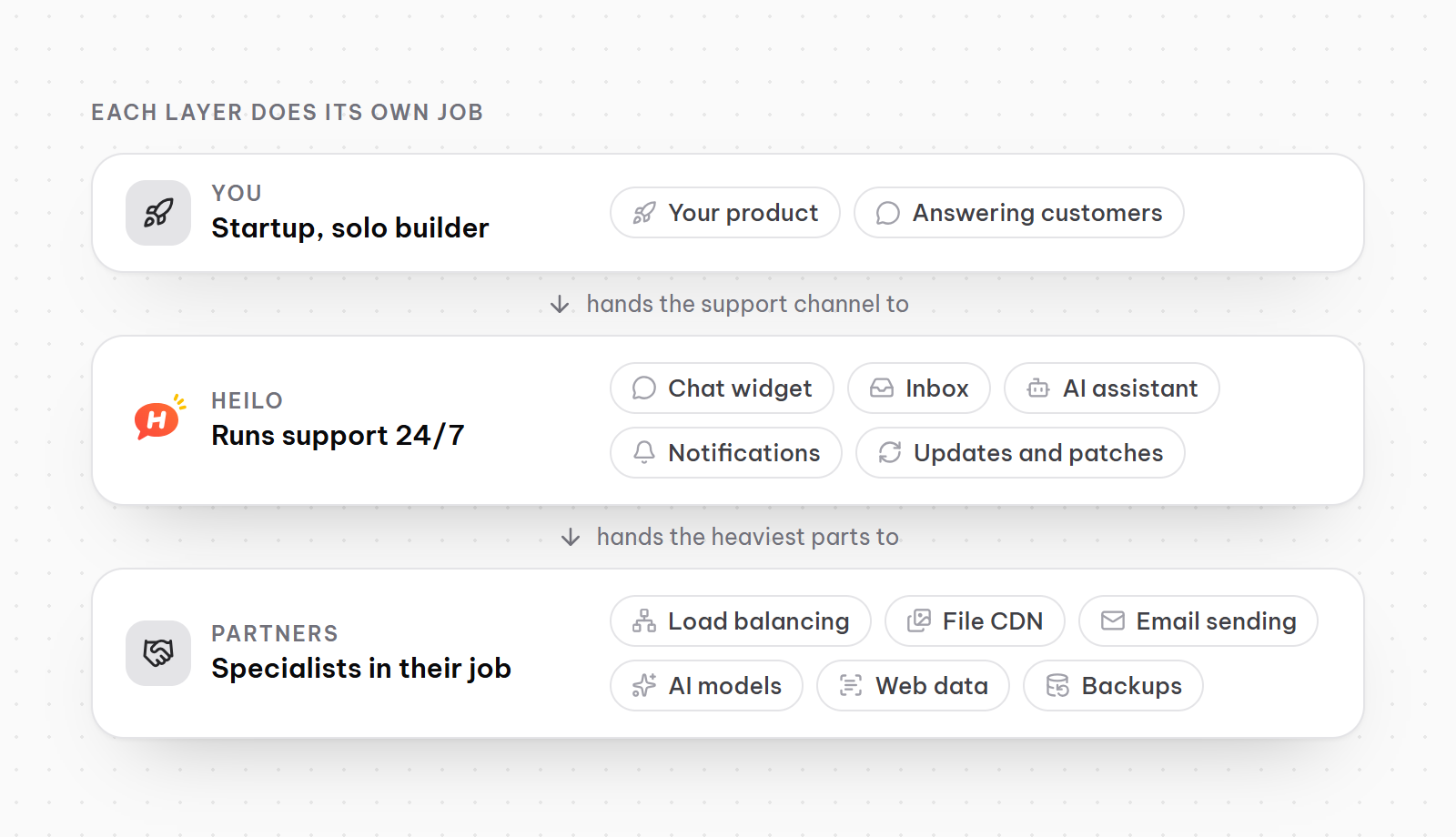
Live chat looks small, but build it yourself and it becomes a second app to maintain alongside your own: a real-time server, file storage, email, push notifications, a phone app for your team, spam protection, backups. Each is a risk, and each tends to need you right when you're busiest. The post on why I built Heilo tells that story in more detail.
For startups and solo builders, pushing that part to Heilo leaves you one app to maintain. Heilo keeps the chat running 24/7, and you look after the product and your customers.
A trusted partner lets you leave
Before you push risk to anyone, ask: if I need to leave, can I take everything with me? With Heilo:
- It fits your app. The widget works right away on every plan, the Widget SDK controls it from JavaScript, and the Chat SDK lets you draw your own interface from Pro.
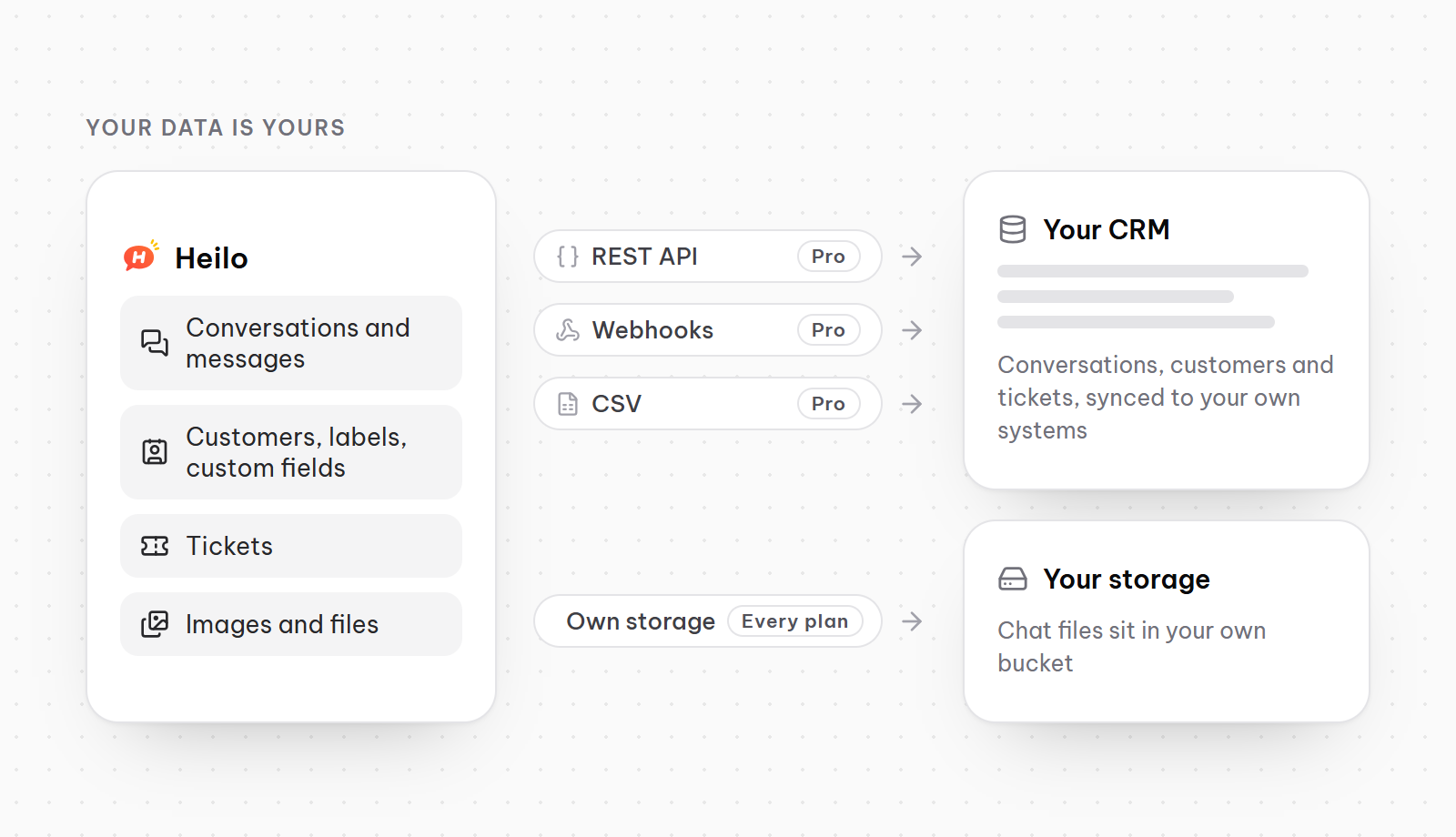
- Your data is yours. The REST API, webhooks and CSV export bring conversations, customers and tickets to your own CRM, on Pro, Business and during the trial (see the REST API and webhooks post). Chat files can sit in your own storage, on every plan.
- No lock-in. Change or cancel your plan any time, and remove the chat by deleting one line of code.
Keep your time for the product
Push risk to partners you trust, and keep your energy for the work only you can do. Heilo does that with its own partners, and hopes to be that kind of partner for your customer support.